)
)
15 May 2026
The epidemiologist teaching healthcare professionals to question AI
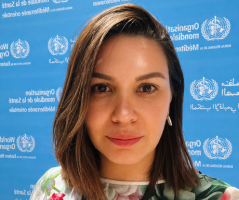
"Every single number we deal with on the screen in an emergency context, those are people with their stories. They are mothers, children, fathers, grandparents," Mona Elbabary told BMJ Future Health.
Elbabary, an epidemiologist with the World Health Emergency Programme at WHO's regional office for the Eastern Mediterranean, runs an AI literacy initiative for professionals working with displaced populations and families living under war. According to Elbabary, the initiative responds to a global concern: AI deployment is moving faster than the ability to use it safely, with many trusting the technology's output simply because it sounds convincing.
Born in Cairo and bilingual in English and Arabic, Elbabary returned to Egypt three years ago after 20 years in Sydney, swapping Australia's step counting and healthy eating culture for Egypt's love of sweet treats, which she enjoys equally.
She arrived confident she understood the region, but quickly learnt how diverse it is, from the wealthy Gulf states to conflict affected Sudan and Yemen. The region covers 22 countries and around 700 million people, including the settings of some of the world's most complex humanitarian crises, among them Gaza and Afghanistan.
AI literacy, Elbabary says, is not a technical course on AI tools but the practical knowledge needed to use them safely. "It's about what AI can and can't do, how to use it responsibly, and the risks and limitations built into this technology."
Elbabary said that the stakes of low AI literacy are higher in the region than in most other settings, because AI tools trained on data from wealthy health systems, then deployed in fragile ones risk amplifying the inequalities they are meant to address. The cost, she said, is borne by people who already have the least.
To reduce that risk, Elbabary made four recommendations specifically for clinicians and emergency officers:
Elbabary, an epidemiologist with the World Health Emergency Programme at WHO's regional office for the Eastern Mediterranean, runs an AI literacy initiative for professionals working with displaced populations and families living under war. According to Elbabary, the initiative responds to a global concern: AI deployment is moving faster than the ability to use it safely, with many trusting the technology's output simply because it sounds convincing.
Born in Cairo and bilingual in English and Arabic, Elbabary returned to Egypt three years ago after 20 years in Sydney, swapping Australia's step counting and healthy eating culture for Egypt's love of sweet treats, which she enjoys equally.
She arrived confident she understood the region, but quickly learnt how diverse it is, from the wealthy Gulf states to conflict affected Sudan and Yemen. The region covers 22 countries and around 700 million people, including the settings of some of the world's most complex humanitarian crises, among them Gaza and Afghanistan.
AI literacy, Elbabary says, is not a technical course on AI tools but the practical knowledge needed to use them safely. "It's about what AI can and can't do, how to use it responsibly, and the risks and limitations built into this technology."
Elbabary said that the stakes of low AI literacy are higher in the region than in most other settings, because AI tools trained on data from wealthy health systems, then deployed in fragile ones risk amplifying the inequalities they are meant to address. The cost, she said, is borne by people who already have the least.
To reduce that risk, Elbabary made four recommendations specifically for clinicians and emergency officers:
- Know where data goes and what can be shared
- Maintain a critical mind: a tool trained on high income country data may give a confident output in rural Africa, but is it relevant?
- Be aware of large language model (LLM) limitations, including hallucinations and bias
- Practise with prompting, since output depends on input quality
Clinicians and emergency officers need to remember that AI supports decisions but can never make them, she said, adding: "You don't want to add another layer of risk to people going through the hardest hardship on the globe."
Elbabary spoke on this topic as part of our panel, "Digital health where it matters most: innovation in humanitarian response," at BMJ Future Health Middle East on 13 May. You can purchase post-event access via the website.
Competing interests: Aside from working for WHO, Elbabary has no competing interests.